Irish High Crosses
Tuam The Market Cross The High Cross of Tuam also known as 'The Market Cross' is comprised of two separate 12th century sandstone crosses. The head, shaft and base were assembled together for the Great Industrial Exhibition in Dublin in 1853. Later, in 1874, the three parts were again re-assembled and moved to the Market Square in Tuam. It stood here until 1990 before finally being moved to St Mary's, Church of Ireland, Cathedral for protection from the elements. The west face of the 1.2 metre wide ringed head, bears a depiction of the Crucifixion, pictured below. The east face bears a figure of a Bishop in high relief at the centre, flanked be two smaller figures on each arm. On the ends of each arm is another small figure, the undersides of the arms are decorated with interlace, see images below.
|
|
North Arm |
South Arm |
The shaft of the cross, which has always been associated with the base, is almost completely covered in beautiful, lightly carved, Urness-style decoration, apart from a large panel of interlace. The north face, pictured below left, bears exstremely stunning examples of the urness style. There is a rectangular hole at the bottom of the shaft on the north side and also at the top of the shaft on the west face. |
|
North-West face |
East face |
North face detail |
South face detail |
West Base Even more interesting than the highly decorated shaft is the large trapezoidal shaped base. It originally stood in the Old Shambles on the west side of Vicar Street, before the cross was assembled for exhibition. All four sides bear Urnes style decoration, but the west side has two Clerical figures in high relief, with the inscription shown below. There are two small circular cups in high relief on the north and south side of the base.
The inscription on the west side of the base of the cross reads: OR DO THOIRDELBUCH UO CHONCHUBUIR, DON......... IARLATH LAS IN DERNAD IN SA....... "A prayer for Turlogh O'Conor for the ..........Jarlath by whom was made this ......." |
|
North Base |
South Base |
East Base The east face also bears two figures in high relief with similar Urnes decoration, plus another interesting inscription.It reads: OR DO U OSSIN; DONDABBAID LAS IN DERNAD. "A Prayer for O Ossin; For the Abbot, by whom it was made."
|
|
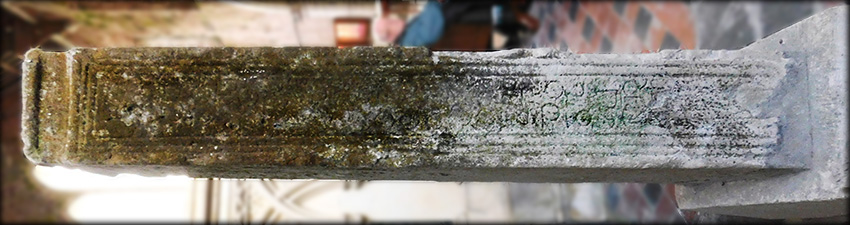
The 2nd Cross Shaft This 12th century sandstone shaft, was found stuck into the earth at the east end of the 'Synod Hall', an early 14th century Gothic choir built to the east of the 12th century Romanesque chancel. The shaft stands 1.45 metres high x 0.45 metres wide and is 0.25 metres deep. The broadest faces bear animal interlace and fretwork patterns. The narrow sides bear the following inscriptions: 'Prayer for the King, Turdelbuch O'Conor [/] Prayer for the wright Gill Christ O'Toole', and the other side reads: 'Prayer for the successor of Iarlath, for Aed O Hossin who had the cross made' Áed Ua h-Oissín, became the first Archbishop of Tuam at the Synod of Kells in 1152. The inscriptions read from top to bottom.
|
|
 |
 |
Ringed Cross A fourth 12th century cross on display in St Mary's Cathedral is the sandstone crosshead pictured below. It was found during the construction of the present Allied Irish Bank on the corner of Dublin Road and Vicar St. This is close to the site of St John's Priory, founded in c.1140 by Turlogh O'Conor, High King of Ireland. The cross was moved to St Jarlath's Diocesen College, where it was cemented into the wall of the ambulatory. In 1976 it was on display at Tuam Mill Museum before finally moving to St Mary's. The pierced wheel-headed cross is only decorated on one face, it consists of irregular rings intertwined with crude interlaced lines, sadly some of the decoration has also flaked away. |
|
 |
 |
|
Situated: St Mary's, Church of Ireland, Cathedral in the centre of Tuam. Discovery Map 39: M 43300 51844. Last Visit: Sept 2025. Longitude: 8° 51' 20.0" W Latitude: 53° 30' 49.4" N Photos: José Gutiérrez. These pictures are reproduced with the kind permission of the Anglican Diocese of Tuam. |
Nearest High Crosses featured on this website Clonmacnois: 75 Kilometres SE. Bealin: 78 Kilometres ESE. Lorrha: 86 Kilometres SE.
|
Ref: Petrie, George. “On the Stone Cross of Tuam.” Proceedings of the Royal Irish Academy (1836-1869), vol. 5, 1850, pp. 470–74. JSTOR, http://www.jstor.org/stable/20489804. Ref: 'Archaeological Inventory of County Galway Vol. II - North Galway'. Compiled by Olive Alcock, Kathy de hÓra and Paul Gosling (Dublin: Stationery Office, 1999). Ref: Rynne, Etienne. “A Fourth High Cross at Tuam.” Journal of the Galway Archaeological and Historical Society, vol. 40, 1985, pp. 125–29. JSTOR, http://www.jstor.org/stable/25535546.
|
|


Previous-----Crosses home-----Next